
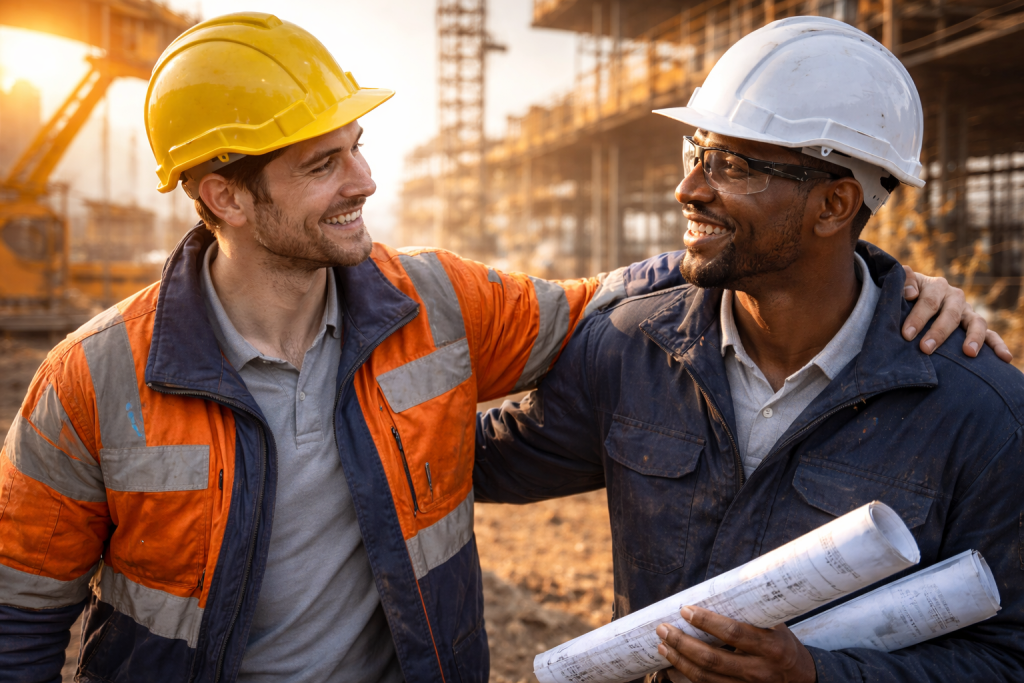
It was just after sunrise at the Vaal Marina construction site.
The air smelled of fresh cement and early ambition.
Siphiwe, a seasoned supervisor known for his firm tone and sharp eye, stood reviewing the day’s checklist when he noticed Lerato, a young scaffolder, sitting quietly near the tool shed, rubbing his temples.
“Lerato,” Siphiwe called, “you alright?”
Lerato hesitated before replying.
“I’m here, sir. Just a bit tired. My daughter’s been sick. I didn’t sleep much.”
Siphiwe paused. Normally, he would’ve reminded Lerato about focus and punctuality. But something in the young man’s voice stopped him.
“Come walk with me,” he said.
They moved past the scaffolding, beyond the noise of machinery. Siphiwe shared a story — one that had stayed with him for years.
“Once, I snapped at a worker for missing a shift. Only later did I learn he’d lost his wife the night before. I didn’t ask. I just assumed. That day taught me something — we all wear boots, yes, but we also carry burdens.”
Lerato nodded quietly.
“It’s hard to focus when your heart’s somewhere else.”
Siphiwe smiled.
“Exactly. That’s why we need to stand in each other’s boots. Not just for safety — but for sanity.”
A Site Transformed
Later that morning, Siphiwe gathered the team.
Instead of the usual safety briefing, he invited everyone to share one thing they were carrying — worries, hopes, or struggles.
The atmosphere shifted.
Laughter mingled with silence. A few tears surfaced. The crew saw one another differently — not just as colleagues, but as people.
From that day forward, the site changed:
- Workers began checking in on each other.
- Supervisors listened more, barked less.
- Mistakes dropped. Morale rose.
- And when Lerato’s daughter recovered, the team celebrated together — like family.
The Lesson: Empathy Builds Safety
Leadership in high-risk industries often focuses on compliance and control. But the heart of safety lies in empathy.
When supervisors take time to understand what their teams are carrying — exhaustion, grief, hope, pride — they don’t just prevent accidents. They build trust.
And when workers feel seen, they bring more than skill to the job. They bring heart.
Standing “in each other’s boots” is not weakness. It’s wisdom.
It’s what transforms a group of individuals into a team — and a worksite into a community.
A Message for Leaders
Worker welfare is not just about policies or checklists.
It’s about presence.
It’s the difference between a leader who says “Be safe” and one who asks “How are you, really?”
Because safety built on empathy lasts longer, runs deeper, and reaches further — from the site to the home, from the heart to the culture.
When leaders choose compassion, they don’t just protect productivity.
They protect people.
Principles & Practice Consultancy (PPC)
Building ethical leadership, trust, and welfare-centered safety cultures — one conversation at a time.
