
Why Small Interactions Have Enormous Emotional Impact
Trust is rarely built through large speeches, formal meetings, or motivational slogans.
It is built in moments.
Small interactions between supervisors and workers often determine whether workers feel psychologically safe, respected, and willing to communicate openly. In many cases, workers decide whether they trust a supervisor within seconds based on tone, body language, facial expression, and emotional behaviour.
Thirty seconds can strengthen trust.
Thirty seconds can damage it.
And because supervisors interact with workers daily, these moments accumulate quickly into workplace culture.
From the worker’s perspective, trust is emotional safety.
Workers constantly evaluate:
- Is this supervisor approachable?
- Will they listen respectfully?
- Will they embarrass me publicly?
- Is it safe to ask questions?
- Will they support me during problems?
- Can I speak honestly around them?
These judgments happen rapidly and often unconsciously.
Human beings are naturally wired to assess emotional safety through social interaction. Workers pay close attention to:
- Tone of voice
- Eye contact
- Facial expression
- Patience
- Listening behaviour
- Respectfulness
- Emotional control
Even brief interactions send powerful emotional messages.
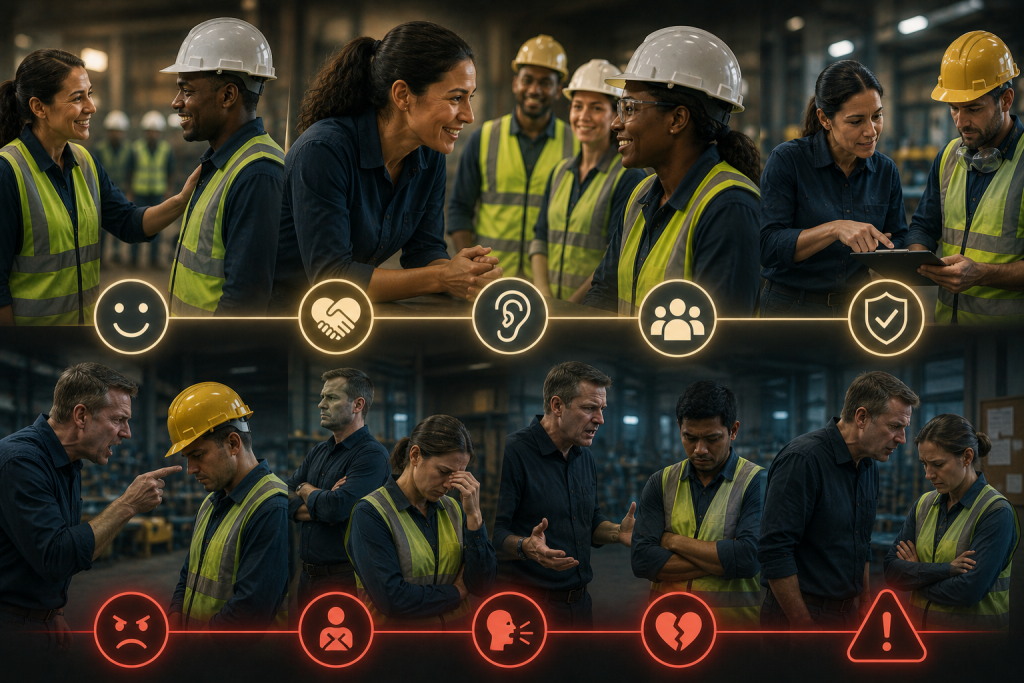
Supervisors build trust quickly when they:
- Greet workers warmly
- Make eye contact
- Use workers’ names respectfully
- Ask how workers are coping
- Listen without rushing
- Remain calm under pressure
- Respond respectfully to concerns
- Show patience during mistakes
These behaviours communicate:
“You matter.”
“You are safe to speak.”
“I respect you.”
This emotional reassurance changes workplace behaviour significantly.
Workers who trust supervisors are more likely to:
- Report hazards
- Ask questions
- Admit mistakes early
- Seek clarification
- Raise concerns honestly
- Participate openly in safety discussions
Trust strengthens communication.
And stronger communication improves safety.
From the leadership perspective, trust acts as a performance multiplier. Teams with high trust:
- Collaborate more effectively
- Share information more openly
- Resolve conflict faster
- Learn more quickly
- Support one another during pressure
- Recover better from mistakes
Workers become more psychologically engaged because emotional energy is spent on contribution rather than self-protection.
The opposite is equally true.
Supervisors can break trust very quickly through seemingly small behaviours:
- Ignoring workers
- Speaking harshly
- Public correction or humiliation
- Impatience
- Dismissive body language
- Interrupting workers
- Showing frustration aggressively
- Failing to follow through on commitments
These moments create emotional distance immediately.
Workers begin protecting themselves psychologically rather than communicating openly. They may remain physically compliant while emotionally withdrawing from leadership.
Importantly, broken trust affects safety directly.
Workers who do not trust supervisors often:
- Stay silent about hazards
- Hide mistakes
- Avoid difficult conversations
- Minimise interaction
- Withdraw emotionally
- Focus on avoiding blame
This silence creates hidden operational risk.
Supervisors must therefore understand that every interaction matters.
Workers do not only remember major incidents or formal meetings. They remember:
- How they were spoken to
- How leaders reacted under pressure
- Whether concerns were dismissed
- Whether dignity was protected
- Whether supervisors remained emotionally stable
Culture is shaped through repeated emotional experiences.
Importantly, trust does not require perfection.
Workers do not expect supervisors to never make mistakes. What they do expect is consistency, fairness, honesty, and emotional maturity. Trust grows when workers repeatedly experience respectful behaviour over time.
Small moments accumulate:
- A calm response during stress
- A sincere greeting
- A respectful correction
- A patient explanation
- A leader taking time to listen
These moments gradually create psychological safety.
Supervisors must also recognise that workers often arrive at work already carrying stress, fatigue, financial pressure, or emotional burdens from outside the workplace. This makes respectful interaction even more important because leadership behaviour can either increase emotional strain or reduce it.
One respectful interaction can stabilise a worker emotionally.
One humiliating interaction can destabilise them for the entire shift.
This emotional influence is powerful.
In high-risk environments especially, workers need supervisors who create calm, trust, and clarity rather than fear or emotional volatility. Workers think more clearly and communicate more openly when they feel emotionally safe.
Trust therefore becomes one of the most important safety tools any supervisor possesses.
And because trust is built in moments, supervisors must understand that even thirty seconds of respectful human interaction can change:
- Communication
- Morale
- Engagement
- Psychological safety
- Team culture
- Safety outcomes
Because workers rarely separate leadership behaviour from workplace experience.
To them, the way supervisors speak, listen, react, and treat people becomes the emotional reality of the workplace itself.
