

Leadership at the Edge of Knowledge and Courage”
Date: 28 July 2025
Introduction:
Most organizations focus on what can be measured. Professor Ikujiro Nonaka challenged us to focus on what can be felt, shared, and acted on with intuition. His SECI Model—Socialization, Externalization, Combination, Internalization—reminds us that knowledge isn’t just data or documentation. (Refer to the next page for more info on the SECI Model) It’s a living exchange between human experience and collective insight.
But it’s in his later work—The Wise Company—that Nonaka truly redefines leadership. He champions “wild leadership”: a fusion of practical wisdom, ethical clarity, and the courage to act in ambiguous terrain. These are not traits you find in an org chart. They’re embodied in leaders who speak with empathy, listen with humility, and move forward even when the answers are imperfect.
Key Reflections:
- Are your leadership decisions driven by spreadsheets—or stories?
- How do you capture and share tacit wisdom across your teams?
- Can you balance decisiveness with moral imagination?
Why It Matters:
✔ Organizations thrive when knowledge is created socially—not stored statically.
✔ “Wild leaders” model psychological safety by encouraging authenticity, risk-taking, and adaptive learning.
✔ Practical wisdom fosters ethical governance—not just technical execution.
Leadership in Action:
- Create spaces for storytelling—not just reporting.
- Value the “unwritten” insights gained through lived experience.
- Encourage leaders to act, reflect, and revise—instead of waiting for certainty.
Closing Thought:
“In turbulent times, the wisest leaders are not those who know everything—but those who know how to listen, learn, and lead ethically through complexity.”
So ask yourself this week:
Are you leading with wild wisdom—or waiting for clarity that may never come?
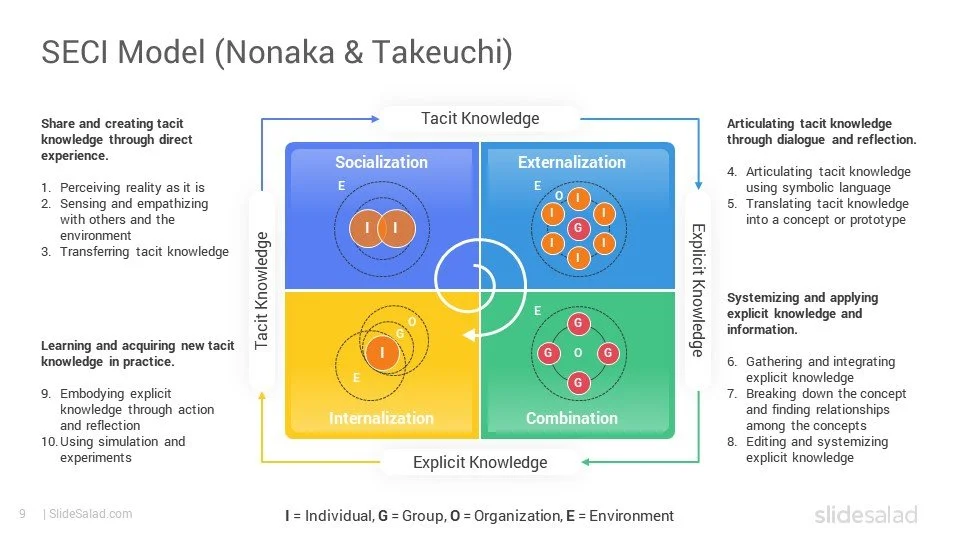
SECI Model Breakdown
How Knowledge Comes Alive Inside Organizations
The SECI Model explains the dynamic process through which tacit knowledge (personal, experience-based, hard to formalize) and explicit knowledge (documented, codified) interact to spark innovation.
Stage
Socialization
Externalization
Combination
Internalization
Description
Sharing experiences through observation, mentoring, and informal conversations.
Articulating tacit knowledge into written concepts, models, or diagrams.
Integrating explicit knowledge from various sources to create new systems.
Embedding explicit knowledge into individual practices through lived application.
Leadership Opportunity
Foster psychological safety and create spaces for experiential exchange.
Encourage storytelling, journaling, and co-creative reflection.
Facilitate structured collaboration and cross-functional learning.
Support hands-on learning and adaptive leadership behaviors.
Key Insight: The model is cyclical and ongoing. As individuals internalize knowledge, they generate new tacit insights—starting the cycle again.
