
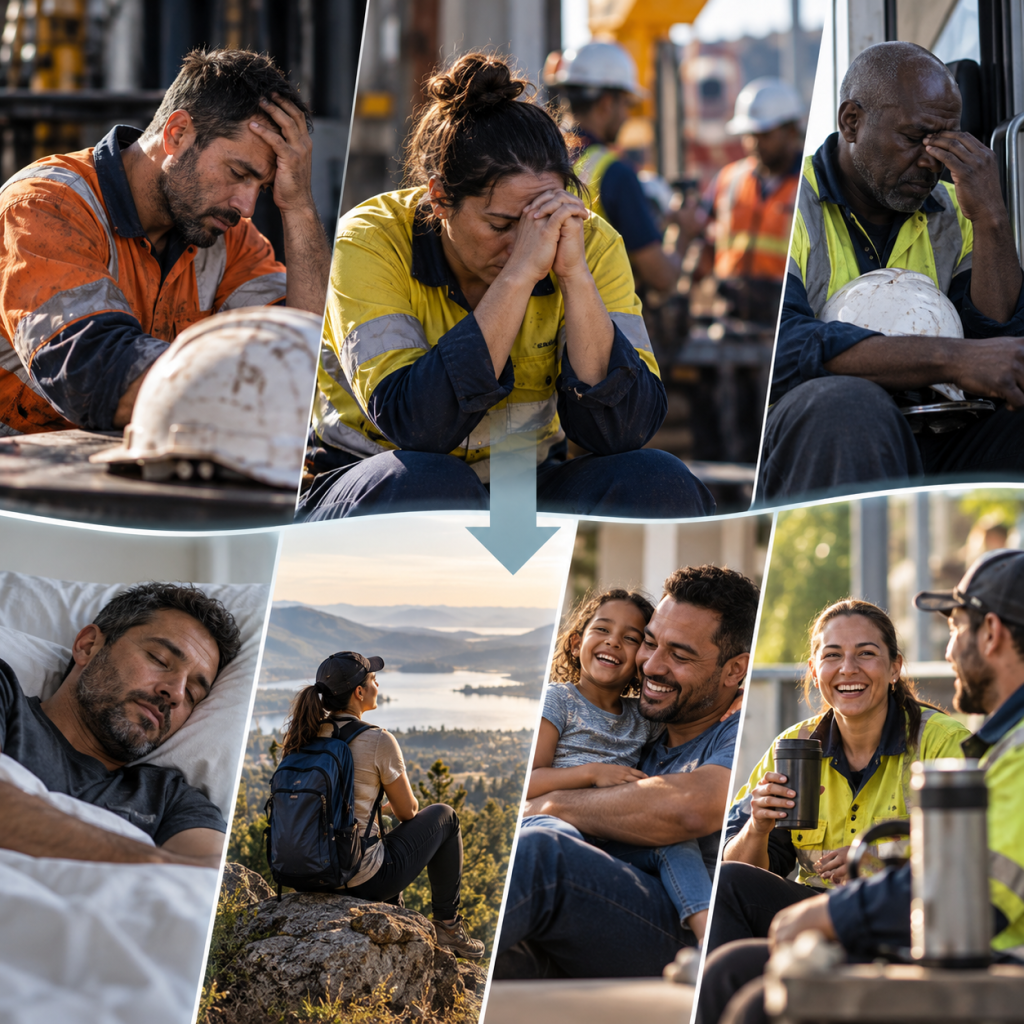
Understanding the Hidden Mental Fatigue Affecting Safety and Performance
Many organisations understand the importance of physical rest.
Workers need sleep.
Workers need breaks.
Workers need time away from physically demanding tasks.
But far fewer organisations recognise the importance of psychological recovery — the mental and emotional restoration workers need in order to think clearly, regulate stress, and remain psychologically healthy over time.
A worker may be physically rested but still mentally exhausted.
This distinction matters deeply in high-risk workplaces.
Psychological fatigue accumulates when workers experience:
- Constant pressure
- Emotional strain
- Conflict
- Fear-based supervision
- Long-term stress
- Exposure to trauma or risk
- Continuous vigilance
- Emotional suppression
- High cognitive demand
Over time, the mind becomes overloaded even when the body appears functional.
From the worker’s perspective, psychological exhaustion often feels invisible.
Workers may struggle to explain:
- Why they feel emotionally drained
- Why concentration feels difficult
- Why patience is disappearing
- Why motivation feels low
- Why small problems suddenly feel overwhelming
Many continue working while silently operating in a state of emotional depletion.
This creates significant safety risk.
Psychologically fatigued workers are more likely to:
- Miss hazards
- Forget critical information
- Make impulsive decisions
- Lose emotional control
- Withdraw socially
- Communicate less effectively
- Struggle with concentration
- Experience slower reaction times
The brain cannot maintain high-level awareness indefinitely without recovery.
From the leadership perspective, psychological recovery is therefore essential for both wellbeing and operational performance.
Workers in high-risk industries often operate under continuous cognitive and emotional pressure. They must remain alert, process information quickly, manage hazards, follow procedures, communicate effectively, and regulate emotions under stress.
This level of mental demand requires recovery — not just sleep.
Importantly, psychological recovery is different from simply “not working.”
A worker may be off duty while still mentally carrying:
- Anxiety
- Worry
- Conflict
- Emotional overload
- Family stress
- Financial pressure
- Fear about work
True recovery occurs when the nervous system has opportunities to settle, decompress, and restore emotional balance.
Without recovery, stress accumulates chronically.
This chronic mental fatigue affects:
- Decision-making
- Emotional regulation
- Cognitive clarity
- Patience
- Memory
- Attention span
- Situational awareness
Eventually, workers begin operating in survival mode rather than optimal functioning.
Why “Pushing Through” Is Dangerous
Many workplace cultures unintentionally glorify endurance:
- “Push through.”
- “Keep going.”
- “Don’t complain.”
- “Toughen up.”
- “Handle it.”
While resilience is valuable, constant emotional suppression without recovery eventually becomes harmful.
From the worker’s perspective, feeling unable to rest psychologically creates guilt and emotional pressure. Workers may believe:
- Rest is weakness
- Stress should be hidden
- Emotional fatigue is failure
- Asking for support is unprofessional
This mindset encourages workers to ignore warning signs until burnout, emotional breakdown, or serious mistakes occur.
Leaders must therefore help normalise psychological recovery as part of healthy performance rather than weakness.
Recovery is not avoidance of work.
Recovery is preparation for safe, sustainable performance.
What Psychological Recovery Looks Like
Psychological recovery occurs when workers experience moments of:
- Emotional calm
- Mental rest
- Reduced pressure
- Positive social connection
- Psychological safety
- Relaxation
- Meaningful personal time
Importantly, recovery looks different for different people.
Some workers recover through:
- Quiet time
- Sleep
- Family connection
- Exercise
- Nature
- Faith practices
- Social interaction
- Music
- Hobbies
- Emotional conversation
What matters is that the nervous system has opportunities to move out of constant stress response.
Without this recovery, emotional strain accumulates silently.
The Role of Leadership in Recovery
Leaders play a major role in either supporting or damaging psychological recovery.
Leaders increase psychological fatigue when they create environments dominated by:
- Fear
- Constant urgency
- Emotional unpredictability
- Excessive workload
- Poor communication
- Lack of support
- Chronic conflict
- Unclear expectations
In contrast, leaders support recovery when they:
- Create calm environments
- Encourage realistic pacing
- Protect breaks and rest periods
- Reduce unnecessary pressure
- Listen to worker concerns
- Support work-life balance
- Respond respectfully during stress
- Promote emotional safety
These behaviours reduce chronic nervous system overload.
From the worker’s perspective, supportive leadership makes recovery feel possible.
Workers are more likely to decompress when they trust that:
- They are respected
- They are psychologically safe
- They are not constantly under emotional threat
- Leadership values wellbeing as well as productivity
This emotional stability improves resilience significantly.
Why Recovery Improves Safety
Psychological recovery directly strengthens safety performance.
Recovered workers:
- Think more clearly
- Notice hazards more effectively
- Regulate emotions better
- Communicate more openly
- Handle pressure more calmly
- Make better decisions
- Stay mentally present
In contrast, emotionally depleted workers often operate on “mental autopilot.”
Autopilot functioning increases risk because workers become:
- Less observant
- Less patient
- More reactive
- More distracted
- More likely to make errors
The brain needs recovery to maintain high-level awareness consistently.
This is especially important in industries involving:
- Heavy machinery
- High-risk environments
- Long shifts
- Continuous vigilance
- Emotional labour
- Exposure to trauma or danger
In these environments, psychological fatigue can become just as dangerous as physical fatigue.
Building Recovery Into Workplace Culture
Strong organisations intentionally create cultures that support recovery rather than glorify exhaustion.
This includes:
- Encouraging healthy breaks
- Respecting leave periods
- Reducing unnecessary after-hours pressure
- Supporting emotional wellbeing
- Promoting respectful leadership behaviour
- Addressing chronic overload proactively
- Creating psychologically safe environments
Importantly, workers should not feel guilty for needing recovery.
Human beings are not machines.
The nervous system requires restoration in order to maintain focus, resilience, emotional regulation, and safe performance over time.
The strongest leaders understand that sustainable performance depends on recovery.
Not just physical recovery.
Psychological recovery too.
Because workers cannot continue giving emotional energy indefinitely without consequence.
Eventually, the mind begins slowing down to protect itself.
And when psychological fatigue is ignored long enough, the cost appears in:
- Mistakes
- Conflict
- Withdrawal
- Burnout
- Disengagement
- Mental health strain
- Safety incidents
Recovery therefore becomes more than self-care.
It becomes a critical part of operational safety and long-term workforce wellbeing.
And organisations that protect psychological recovery create healthier, safer, more resilient teams capable of performing well — not just temporarily, but sustainably over time.
