
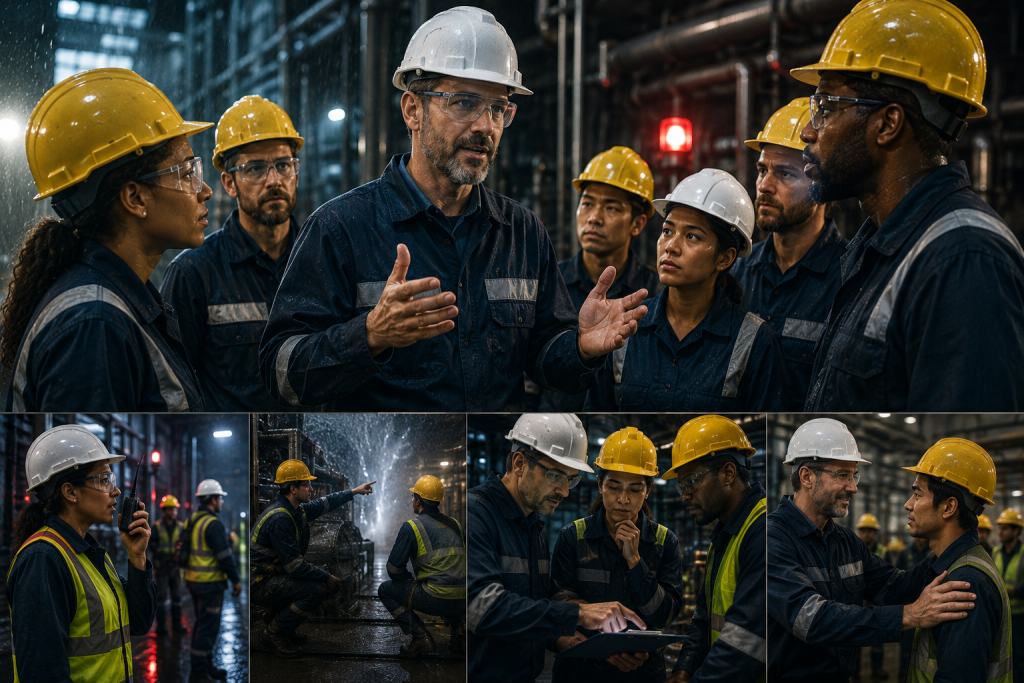
Why Emotional Stability Is One of the Most Important Safety Skills
High-risk workplaces are unpredictable by nature.
Equipment fails.
Deadlines change suddenly.
Weather conditions shift.
Emergencies happen.
People make mistakes.
Unexpected problems appear without warning.
In these moments of uncertainty and pressure, workers instinctively look to leadership for emotional direction. Long before workers analyse technical details, they assess something more immediate:
“How is leadership reacting?”
The emotional behaviour leaders display during chaos often determines whether teams remain focused and safe — or become fearful, reactive, and disorganised.
A calm leader stabilises the environment.
A panicked leader destabilises it.
From the worker’s perspective, chaos creates emotional vulnerability.
During emergencies or stressful operational disruptions, workers may worry about:
- Personal safety
- Making mistakes
- Being blamed
- Losing control
- Letting the team down
- Uncertain outcomes
Stress narrows attention and increases emotional reactivity. If leadership also becomes emotionally reactive, tension escalates rapidly across the entire team.
Workers closely observe:
- Tone of voice
- Body language
- Facial expressions
- Speed of communication
- Emotional control
- Decision-making behaviour
These signals influence whether workers feel psychologically protected or emotionally threatened.
When leaders remain calm, workers feel safer. Calm leadership communicates:
“We can handle this.”
“There is structure.”
“You are not alone.”
“Focus on solutions.”
This emotional stability improves cognitive functioning across teams.
Workers think more clearly when leaders:
- Speak calmly
- Give clear instructions
- Remain emotionally controlled
- Focus on priorities
- Avoid panic or aggression
- Maintain respectful communication
Calmness reduces confusion.
And reduced confusion improves safety.
From the leadership perspective, calmness is not simply personality — it is a professional skill requiring emotional regulation, self-awareness, and intentional behaviour under pressure.
Strong leaders understand that their emotional state spreads quickly through teams.
This phenomenon is often called emotional contagion. Human beings naturally mirror the emotions of people around them, especially authority figures during uncertain situations.
If a leader:
- Panics
- Shouts
- Becomes emotionally volatile
- Speaks aggressively
- Appears overwhelmed
workers absorb that emotional instability immediately.
This creates:
- Anxiety
- Poor communication
- Rushed decisions
- Increased mistakes
- Fear-based behaviour
- Reduced psychological safety
Workers may stop thinking critically because emotional survival takes priority over clear reasoning.
In contrast, emotionally regulated leaders help stabilise nervous systems across teams. Workers become more capable of:
- Listening carefully
- Processing information
- Making thoughtful decisions
- Communicating clearly
- Supporting one another
- Staying situationally aware
This is especially critical in high-risk environments where emotional panic can escalate physical danger rapidly.
Calm leaders create structure during uncertainty.
They:
- Slow communication down
- Prioritise essential information
- Give clear direction
- Reassure the team
- Focus on solutions rather than blame
- Avoid emotional overreaction
Importantly, calmness does not mean pretending problems are unimportant.
Strong leaders acknowledge seriousness honestly while remaining emotionally steady.
Workers do not expect leaders to eliminate difficulty.
They expect leaders to provide emotional stability through difficulty.
This distinction matters deeply.
Calm leadership also protects Worker Voice during stressful situations. Workers remain more willing to:
- Report concerns
- Ask questions
- Clarify uncertainty
- Raise hazards
- Admit mistakes
when leadership behaviour feels emotionally safe.
Panic and aggression silence communication quickly.
Leaders must therefore understand that emotional control directly affects operational awareness.
One calm instruction can prevent confusion.
One emotionally reactive moment can create widespread instability.
Importantly, emotional regulation can be developed.
Leaders strengthen calmness by:
- Practising self-awareness
- Slowing down before reacting
- Managing tone intentionally
- Preparing mentally for high-pressure scenarios
- Focusing on breathing and clarity
- Separating emotion from decision-making
- Modelling steady behaviour consistently
Preparation reduces panic because confident leaders rely on process rather than emotional reaction.
Workers also remember leadership behaviour during difficult moments far more strongly than during ordinary days.
Years later, workers may forget operational details — but they will remember:
- Who stayed calm
- Who protected dignity
- Who communicated clearly
- Who created stability during fear
These moments define leadership credibility.
Importantly, calmness builds trust because workers feel emotionally safer around leaders who remain stable under pressure. Teams become more resilient because emotional steadiness reduces chaos rather than amplifying it.
Strong leadership during crisis therefore involves more than technical decision-making.
It involves emotional leadership.
The ability to regulate fear, stabilise communication, and create psychological safety during uncertainty becomes one of the most powerful forms of protection any leader can provide.
Because chaos is inevitable in high-risk environments.
But panic is not.
And the leaders who learn to create calm during uncertainty do far more than manage emergencies — they create workplaces where workers feel safer, think clearer, communicate better, and trust more deeply even during the most difficult moments.
