
Building Psychological Safety Across Language and Cultural Differences
Modern workplaces are increasingly multilingual. Workers from different language groups, cultures, and educational backgrounds often work together in high-pressure environments where communication directly affects safety, teamwork, and operational performance.
This diversity brings enormous strength.
Multilingual teams offer broader perspectives, stronger adaptability, and richer cultural understanding. But they also create communication challenges that leaders must intentionally manage with care, patience, and emotional intelligence.
When workers struggle to express themselves confidently, Worker Voice weakens.
A worker may clearly recognise a hazard, understand a problem completely, or have valuable insight to contribute — yet remain silent because they fear being misunderstood, embarrassed, or judged for how they speak.
This silence can become dangerous in high-risk environments.
From the worker’s perspective, language barriers create vulnerability.
Workers may worry:
- “What if I say it incorrectly?”
- “What if people laugh at me?”
- “What if leadership becomes impatient?”
- “What if I cannot explain the risk properly?”
- “What if I sound uneducated?”
- “What if I misunderstand instructions?”
These fears are deeply emotional, not simply technical.
Communication becomes stressful when workers feel their language ability will affect how they are perceived or treated. Instead of focusing fully on safety or collaboration, workers begin focusing on protecting themselves from embarrassment.
This reduces openness significantly.
Workers may:
- Stay quiet during meetings
- Avoid asking questions
- Pretend to understand instructions
- Avoid reporting concerns
- Withdraw socially
- Depend excessively on others to speak for them
The risk increases when workers believe leadership values speed or authority more than understanding.
From the leadership perspective, multilingual teams require intentional communication strategies.
Leaders must understand that effective communication is not only about giving instructions clearly — it is about ensuring workers feel psychologically safe enough to engage openly regardless of language ability.
This requires patience, humility, and cultural awareness.
Strong leaders create environments where workers know:
“It is okay to ask again.”
“It is okay to speak imperfectly.”
“It is okay to seek clarification.”
Psychological safety becomes especially important in multilingual environments because workers are already operating with increased emotional vulnerability.
Leaders can strengthen Worker Voice in multilingual teams by:
- Using simple, clear language
- Speaking slowly and calmly
- Avoiding jargon or overly technical wording
- Encouraging workers to explain concerns in their home language if needed
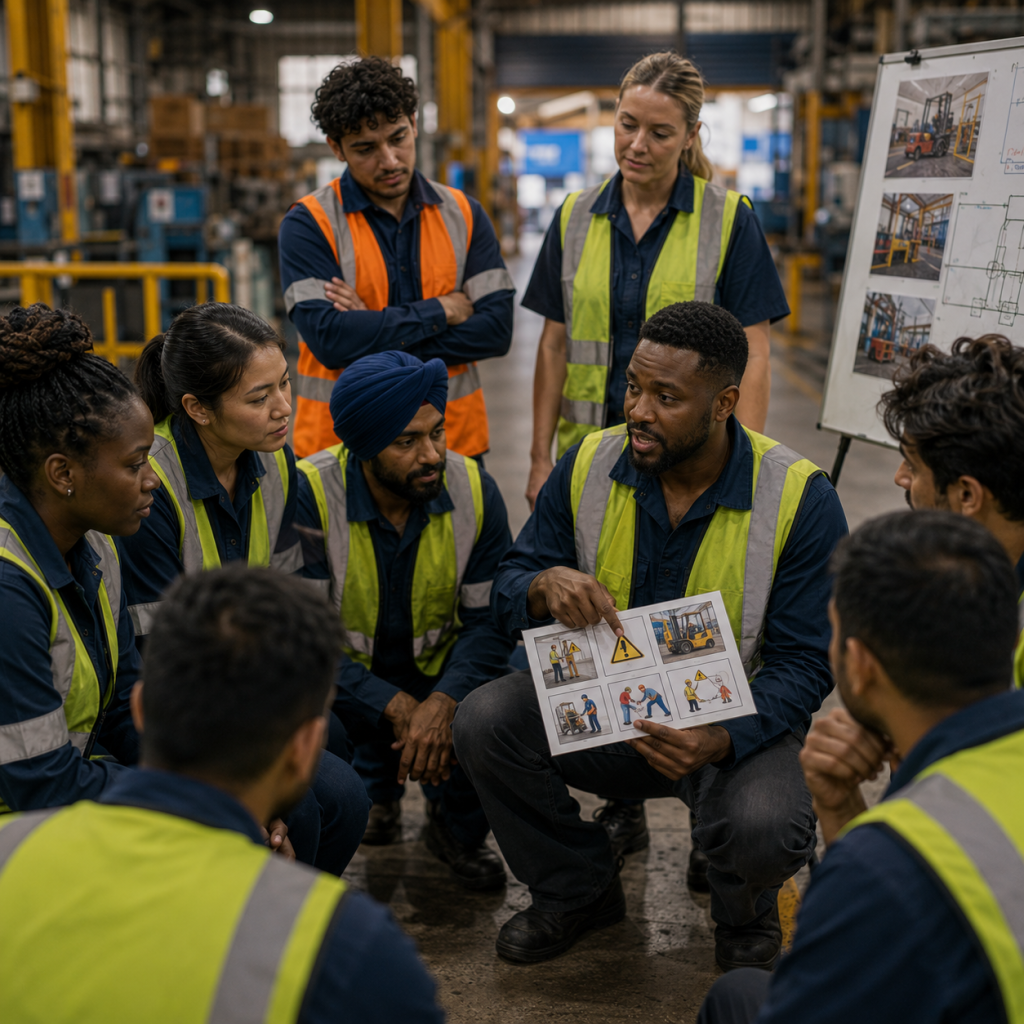
- Using visual aids, demonstrations, and diagrams
- Confirming understanding respectfully
- Encouraging questions without pressure
- Training bilingual workers as communication champions
- Avoiding sarcasm, impatience, or public correction
Importantly, checking understanding must be done carefully.
Workers often say “yes” even when they are unsure because they fear embarrassment or delaying work. Leaders should therefore avoid asking:
“Do you understand?”
Instead, leaders can ask:
“Can you show me how you will do this?”
“Talk me through your understanding.”
“What concerns do you see?”
This encourages active communication rather than passive agreement.
Visual communication is also extremely valuable in multilingual workplaces. Demonstrations, signage, colour coding, diagrams, videos, and hands-on explanation often improve understanding far more effectively than verbal instruction alone.
Leaders must also recognise the emotional significance of language.
A person’s language is deeply connected to identity, dignity, culture, and belonging. When workers feel mocked, dismissed, or judged because of their accent or language ability, emotional withdrawal often follows.
But when leaders respect all languages, workers feel respected as people.
This emotional shift changes behaviour.
Workers who feel linguistically safe are more likely to:
- Raise concerns
- Ask questions
- Report hazards
- Participate in discussions
- Collaborate across teams
- Share ideas confidently
Multilingual teams also benefit greatly from peer support structures. Bilingual workers can act as trusted communication bridges, helping explain instructions, clarify concerns, and reduce misunderstandings.
These “language champions” strengthen inclusion while reducing communication anxiety.
Importantly, leaders themselves set the emotional tone.
Workers observe carefully whether leadership responds to language difficulties with:
- Patience or frustration
- Respect or mockery
- Calmness or irritation
- Encouragement or embarrassment
These reactions determine whether workers feel emotionally safe enough to speak.
Inclusion in multilingual environments is therefore not simply about translation.
It is about dignity.
Workers must feel that their voice matters regardless of how perfectly they speak. When leaders create emotionally safe communication environments, workers stop focusing on fear and start focusing on contribution.
This improves:
- Safety communication
- Teamwork
- Trust
- Engagement
- Collaboration
- Hazard reporting
- Morale
The strongest multilingual teams are not those where everyone speaks perfectly.
They are the teams where everyone feels safe enough to communicate honestly.
Because when workers feel valued beyond language barriers, they stop protecting themselves emotionally — and start participating fully as partners in safety, teamwork, and organisational success.
