
How Fear Quietly Destroys Communication, Trust, and Safety
Fear is one of the strongest forces shaping human behaviour in the workplace. It influences how workers think, communicate, react under pressure, and decide whether it feels safe to speak honestly.
Yet fear rarely appears openly in organisational reports or safety statistics.
Instead, it hides beneath silence.
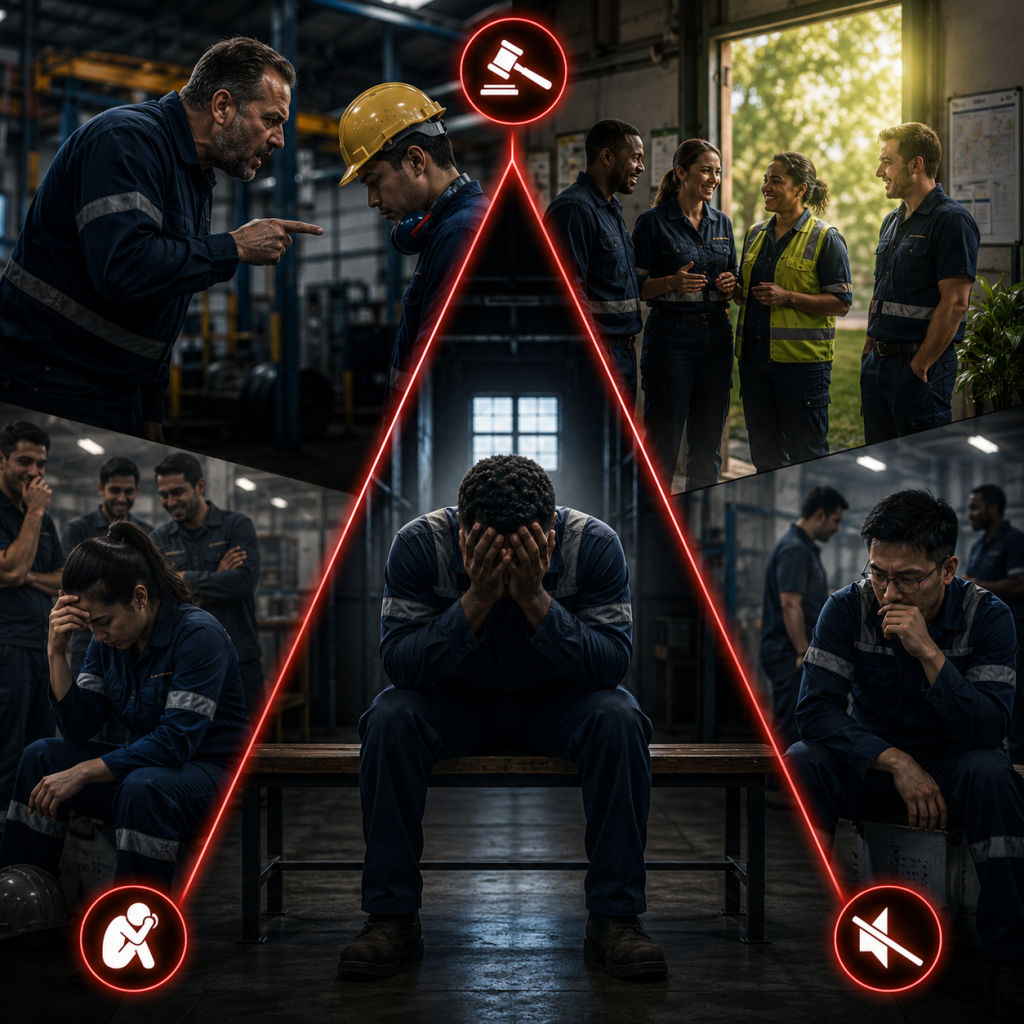
In many workplaces, fear forms a destructive cycle — a “Fear Triangle” built on punishment, shame, and silence. Each element strengthens the others, gradually creating cultures where workers protect themselves emotionally rather than communicate openly.
At first glance, the workplace may appear functional. Tasks are completed, workers follow instructions, and operations continue. But beneath the surface, communication becomes restricted, honesty decreases, and psychological safety weakens.
Workers stop speaking not because they do not care — but because fear has taught them that silence feels safer than vulnerability.
Punishment: The Fear of Consequences
The first side of the triangle is punishment.
Workers quickly learn how leadership responds to mistakes, questions, delays, or concerns. If previous experiences involved shouting, blame, threats, lost opportunities, public criticism, or harsh reactions, workers begin associating honesty with danger.
From the worker’s perspective, speaking up becomes risky.
Workers may fear:
- Losing overtime
- Being singled out
- Public criticism
- Damage to reputation
- Aggressive supervisors
- Losing trust from leadership
- Being labelled as difficult or negative
This fear fundamentally changes behaviour.
Instead of asking:
“What is safest?”
workers begin asking:
“What protects me emotionally?”
The result is silence, avoidance, and emotional self-protection.
Workers may hide mistakes, avoid raising concerns, or continue unsafe work because the emotional consequences of honesty feel greater than the physical risk itself.
This creates hidden danger throughout the organisation.
Importantly, punishment does not always need to be formal to create fear. Often, subtle reactions have powerful emotional effects:
- Frustrated body language
- Sarcastic comments
- Public impatience
- Aggressive tone
- Dismissive responses
- Embarrassing questions in front of others
Workers remember these moments deeply because they shape emotional safety.
Shame: The Emotional Wound That Silences Workers
The second side of the triangle is shame.
Shame is one of the most powerful emotional experiences human beings can feel because it attacks dignity and identity. Workers fear embarrassment almost as much as they fear punishment.
A supervisor correcting someone publicly.
A sarcastic remark about a mistake.
Laughter after a misunderstanding.
Being humiliated during a meeting.
These moments can emotionally silence workers for long periods.
From the worker’s perspective, shame feels deeply personal. It creates the emotional message:
“You are inadequate.”
“You are foolish.”
“You are not respected.”
This emotional pain changes future behaviour dramatically.
Workers who experience shame often:
- Avoid speaking in meetings
- Stop asking questions
- Withdraw socially
- Hide uncertainty
- Fear making mistakes publicly
- Become emotionally guarded
Shame reduces psychological safety faster than many leaders realise.
Even workers who witness others being humiliated learn an important lesson:
“Do not expose yourself emotionally.”
This creates team-wide silence because workers begin protecting themselves from embarrassment rather than engaging openly.
In high-risk environments, this is especially dangerous.
Workers who fear shame may avoid:
- Reporting hazards
- Clarifying instructions
- Challenging unsafe decisions
- Admitting confusion
- Asking for help
The workplace loses openness, learning, and honest communication.
Silence: The Hidden Hazard
The final side of the triangle is silence.
When punishment and shame dominate workplace culture, silence naturally follows.
Workers stop:
- Reporting issues
- Raising concerns
- Sharing ideas
- Admitting mistakes
- Asking questions
- Challenging unsafe behaviour
Silence becomes a survival strategy.
From the worker’s perspective, silence feels safer than honesty because it reduces emotional exposure. Workers begin focusing on avoiding negative attention rather than contributing openly to safety and improvement.
But silence creates enormous organisational risk.
Hidden hazards remain unresolved.
Near misses go unreported.
Learning opportunities disappear.
Unsafe behaviours continue unchallenged.
The organisation loses access to critical information because workers no longer trust the emotional environment enough to speak honestly.
This is why silence should never be interpreted as agreement, satisfaction, or safety.
Often, silence means workers are afraid.
Breaking the Fear Triangle
From the leadership perspective, breaking the Fear Triangle requires emotionally intelligent leadership and intentional culture-building.
Fear-based environments do not disappear through policies alone. Workers must repeatedly experience psychological safety before trust can return.
Leaders can begin breaking the triangle by:
- Correcting workers privately instead of publicly
- Responding calmly during mistakes
- Listening without judgment
- Encouraging questions openly
- Thanking workers for honesty
- Focusing on learning rather than blame
- Protecting workers who raise concerns
- Avoiding emotionally aggressive reactions
These behaviours communicate:
“It is safe to speak here.”
“You will not be humiliated.”
“Your honesty matters.”
Over time, workers begin testing whether the environment has truly changed. They may start by raising small concerns first. Leadership responses during these moments are critical because workers are evaluating whether openness is genuinely safe.
Trust rebuilds slowly through consistency.
Importantly, leaders must recognise that emotional safety directly affects physical safety.
Workers who trust leadership:
- Report hazards earlier
- Communicate more openly
- Admit mistakes sooner
- Ask questions freely
- Engage proactively in safety
- Collaborate more effectively
In contrast, fear-based environments create emotional isolation and operational blindness.
The most effective organisations understand that eliminating fear is not about reducing accountability. Workers still need clear expectations, discipline, and responsibility.
But accountability without humiliation creates learning.
Accountability through fear creates silence.
Strong leaders therefore focus on preserving dignity while maintaining standards.
Because workers perform best in environments where they feel psychologically safe enough to:
- Think
- Question
- Speak
- Learn
- Admit mistakes
- Be human
The Fear Triangle weakens culture because it replaces trust with emotional survival. But when leaders remove fear, communication returns.
When communication returns, hazards surface earlier.
And when workers feel safe to speak honestly, safety becomes far stronger across the entire organisation.
